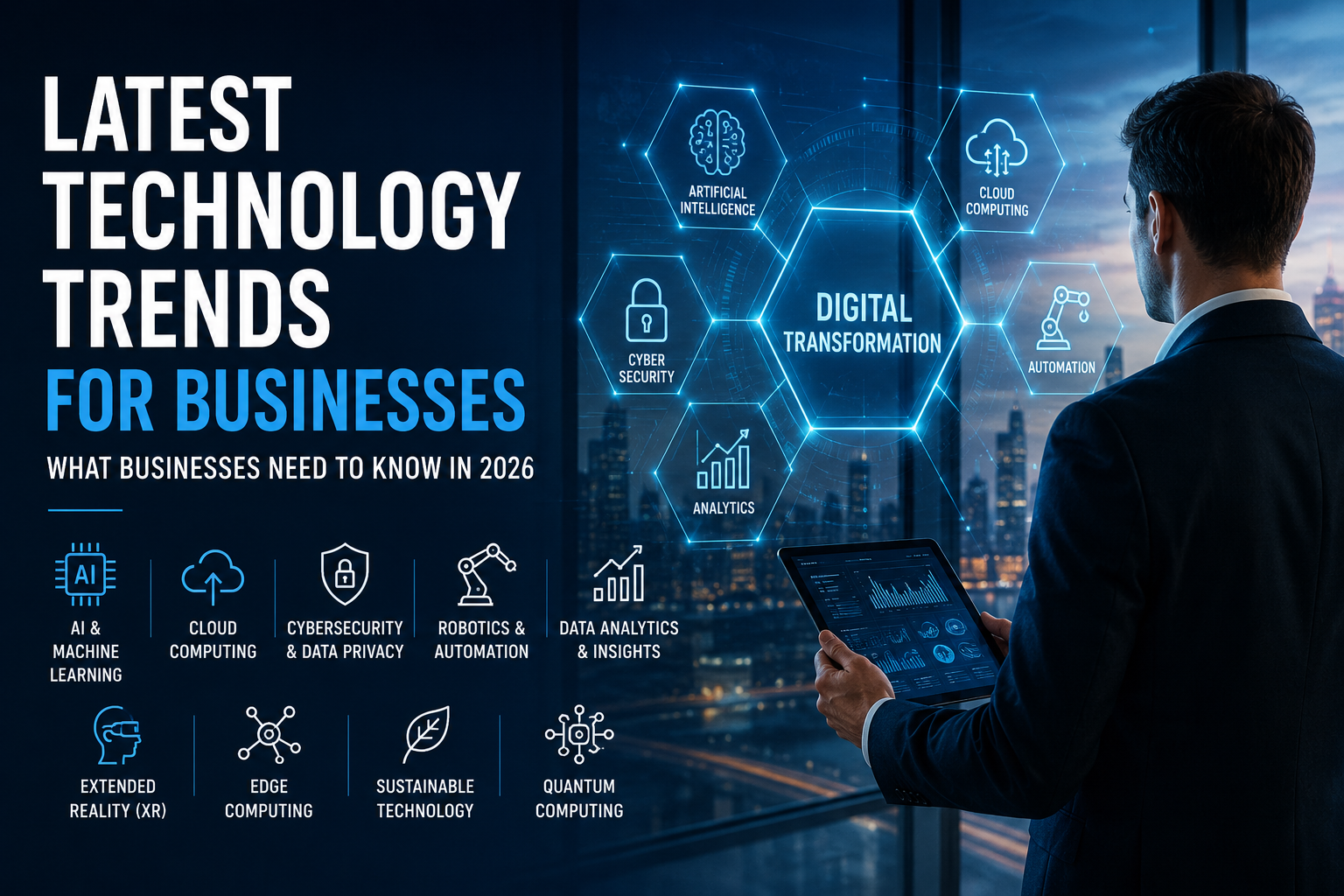

Businesses are entering a period in which technology is becoming closely connected with everyday decision-making, customer service, cybersecurity, software development, and operations. The latest technology trends for businesses in 2026 are particularly focused on artificial intelligence, AI agents, specialized AI models, AI-assisted software development, advanced computing, cybersecurity, data protection, and intelligent automation.
However, technology adoption is not simply a matter of buying the newest software. A useful business technology needs to solve a genuine problem, work reliably with existing systems, protect sensitive information, and provide enough value to justify its cost. Some technologies discussed in 2026 are already being used commercially, while others are still developing and should be evaluated carefully.
What Are the Latest Technology Trends for Businesses?
The latest technology trends for businesses are emerging technologies and changing digital practices that can influence how organizations operate, make decisions, serve customers, manage information, and protect their systems.
Artificial intelligence is currently one of the strongest themes. Gartner’s Strategic Technology Trends for 2026 include AI-native development platforms, AI supercomputing platforms, confidential computing, multiagent systems, domain-specific language models, physical AI, preemptive cybersecurity, digital provenance, AI security platforms, and geopatriation.
These trends do not have equal importance for every company. A software company may benefit from AI-assisted development, while a manufacturer may have more practical reasons to investigate robotics and physical AI. A financial organization may place greater emphasis on security, privacy, specialized AI models, and regulatory requirements.
The most sensible approach is therefore to evaluate technology according to business needs rather than adopting a trend simply because it is receiving attention.
Background: How Business Technology Has Changed
Business technology has changed considerably over the past several decades.
Early business computing concentrated on tasks such as accounting, databases, payroll, inventory management, word processing, and other repetitive information-processing activities. The arrival of widespread internet access expanded the role of technology into communication, e-commerce, digital marketing, online banking, and customer support.
Cloud computing later changed how companies acquired and operated IT infrastructure. Instead of purchasing and maintaining every server themselves, businesses could obtain computing resources and software through cloud providers and subscription-based services.
Mobile devices further changed customer expectations. Businesses could communicate with customers outside traditional offices and provide services through websites and applications.
Artificial intelligence represents another significant shift because software can now perform tasks involving language, pattern recognition, prediction, classification, summarization, and content generation.
The change is not limited to AI. The World Economic Forum’s Future of Jobs Report 2025 identifies technological developments including AI and information processing, robotics and automation, and energy technologies as important forces expected to affect jobs and business activity through 2030.
This means modern technology strategy increasingly involves several connected areas rather than a single piece of software.
How New Technology Is Changing Business Operations
Technology can affect almost every stage of a business process.
A customer inquiry, for example, may enter through a website, be classified automatically, stored in a customer relationship management system, routed to an employee, and analyzed later to identify recurring problems.
In another organization, employees may use AI to summarize lengthy documents, generate first drafts, search internal information, or assist with software development. These applications still require appropriate review because an AI-generated output is not automatically accurate.
Modern business technology also depends heavily on underlying infrastructure. Cloud computing, databases, networking, APIs, cybersecurity systems, identity management, and computing hardware all contribute to whether a digital service works reliably.
The result is an increasingly interconnected technology environment. A decision to introduce AI can therefore affect data governance, cybersecurity, employee training, software architecture, and compliance at the same time.
For Reading More informative Articles Visit: Washingtondaily.blog
Major Latest Technology Trends for Businesses
1. Generative AI Is Moving Into Everyday Business Work
Generative artificial intelligence has become one of the most visible developments in business technology.
Unlike traditional software that follows predefined instructions, generative AI can produce text, code, summaries, images, and other outputs based on user prompts and available data.
Businesses are using these capabilities for tasks such as drafting documents, summarizing information, assisting developers, preparing marketing material, analyzing business information, and supporting customer-service workflows.
The practical value depends heavily on the task. Generative AI may be useful for producing a first draft or organizing information, but businesses should not assume that every generated answer is correct.
Accuracy is particularly important when AI is used for financial information, legal material, technical documentation, customer decisions, or other sensitive work.
NIST’s Artificial Intelligence Risk Management Framework: Generative Artificial Intelligence Profile recommends considering risks associated with generative AI throughout the AI lifecycle rather than treating risk management as something that happens only after deployment.
Why businesses are interested in generative AI
The attraction is relatively straightforward: businesses have many information-heavy tasks that consume employee time.
AI can potentially assist with parts of those processes without requiring every employee to become a specialist in machine learning.
The sensible objective is not necessarily to replace an entire business process. Often, the better starting point is to identify one repetitive or information-heavy task where AI can provide assistance while employees remain responsible for important decisions.
2. AI Agents and Multiagent Systems
A major development beyond conventional chatbots is the growing interest in AI agents.
A basic AI assistant may answer a question or generate text. An agent can be designed to perform a sequence of actions using connected tools and systems.
For example, a business agent could potentially retrieve information, organize it, prepare a response, update a permitted system, and request human approval before completing a sensitive action.
IBM’s 2025 CEO Study on AI agents and enterprise transformation reported that 61% of surveyed CEOs said their organizations were actively adopting AI agents and preparing to implement them at scale.
That figure describes the surveyed organizations and should not be interpreted as proof that most businesses globally have already deployed AI agents.
Gartner also identifies multiagent systems as one of its strategic technology trends for 2026.
Why AI agents require caution
An AI system that can take actions creates different risks from a system that only produces suggestions.
Businesses need to think about permissions, authentication, logging, human approval, data access, error handling, and the ability to stop or reverse an action.
For sensitive processes, giving an AI agent unrestricted access to business systems would be difficult to justify without appropriate technical and organizational safeguards.
3. Domain-Specific Language Models
Another important trend is the movement toward specialized AI models designed for particular industries, functions, or business processes.
A general-purpose model may be capable of discussing many subjects, but a business may need an AI system that understands specialized terminology and context.
A legal organization, for example, has different requirements from a manufacturing company. A financial institution also faces different information and compliance considerations from a retailer.
Gartner identifies domain-specific language models as a strategic technology trend for 2026 and describes them as models designed for specialized business or industry requirements.
Specialization does not automatically guarantee accuracy. Businesses still need to evaluate the quality of training or reference data, model performance, security, cost, and suitability for the intended task.
4. AI-Native Software Development
AI is also changing how software is developed.
Modern development tools can assist programmers with code generation, code explanation, debugging, documentation, testing, and other development tasks.
Gartner lists AI-native development platforms among its 2026 strategic technology trends.
For businesses, the important distinction is between assistance and responsibility.
AI-generated code still needs to be reviewed and tested. Security vulnerabilities, incorrect logic, poor architecture, dependency problems, and maintenance issues can still occur.
A development team therefore needs processes for reviewing AI-assisted work rather than treating generated code as automatically production-ready.
5. AI Supercomputing and Specialized Computing Infrastructure
AI workloads can require substantial computing resources, particularly when organizations train or operate larger models.
This is contributing to greater interest in specialized computing infrastructure involving GPUs, AI accelerators, high-speed networking, memory, and other components designed for demanding workloads.
Gartner lists AI supercomputing platforms as a 2026 strategic technology trend.
For many smaller companies, however, purchasing specialized AI infrastructure may not be necessary. Cloud-based AI services can provide access to computing resources without requiring a company to build a large physical infrastructure environment.
The right choice depends on workload requirements, data sensitivity, cost, latency, scalability, and technical expertise.
6. Cybersecurity Is Becoming More Closely Connected to AI
The growth of AI creates opportunities as well as security concerns.
Businesses must protect traditional systems while also considering AI-specific risks. These can include inappropriate data exposure, malicious prompts, unauthorized access, unsafe integrations, and misuse of AI-enabled systems.
NIST’s Trustworthy and Responsible AI Resource Center identifies security and resilience as important characteristics of trustworthy AI and notes that AI systems share many cybersecurity concerns with other software and computing systems.
Gartner’s 2026 trends also include preemptive cybersecurity and AI security platforms.
The underlying principle is simple: cybersecurity should be considered before a new technology is deployed, not after an incident occurs.
7. AI Security and Governance
As companies adopt more AI tools, simply having a cybersecurity policy may not be enough.
Organizations need to know which AI applications employees are allowed to use, what data can be processed, how outputs should be reviewed, and who is responsible when an AI system produces an error.
AI governance can include:
- Approved and prohibited AI tools
- Data-handling requirements
- Access controls
- Human review procedures
- Security testing
- Vendor assessment
- Documentation
- Incident reporting
- Model evaluation
NIST’s AI Risk Management Framework provides a voluntary framework for organizations designing, developing, deploying, or using AI systems. Its approach emphasizes managing AI risks and supporting trustworthy and responsible AI use.
This does not mean every company needs a large AI governance department. Smaller businesses can adapt the principles to the scale and risk of their operations.
8. Confidential Computing and Protection of Sensitive Data
Data security is becoming more complicated because organizations increasingly process valuable information through cloud and distributed computing environments.
Confidential computing is designed to protect data while it is being processed by using hardware-based trusted execution environments.
Gartner includes confidential computing among its strategic technology trends for 2026 and describes it as a technology for protecting sensitive workloads while they are in use.
This may be particularly relevant to organizations handling sensitive business, financial, personal, or regulated information.
It is not a replacement for ordinary cybersecurity. Encryption, identity controls, secure software development, network security, and access management remain important.
9. Physical AI, Robotics, and Intelligent Machines
AI is also moving beyond screens and software into physical environments.
Physical AI refers to AI-enabled systems that interact with the physical world. Examples can include robots, drones, autonomous equipment, and intelligent machines.
Gartner lists physical AI among its 2026 strategic technology trends.
Manufacturing, logistics, warehousing, agriculture, and other physical industries may have practical reasons to investigate these systems.
However, physical AI introduces challenges that ordinary software does not face. A physical machine must operate safely around equipment and people, deal with changing environments, and respond appropriately when something unexpected occurs.
That makes testing, maintenance, safety controls, and human supervision particularly important.
10. Digital Provenance and Technology Trust
The growing use of AI-generated material is increasing interest in understanding where digital content and software components originate.
Digital provenance refers broadly to information about the origin, history, or integrity of digital assets.
Gartner includes digital provenance among its 2026 strategic technology trends, connecting it with the growing complexity of digital supply chains and AI-generated material.
For businesses, provenance can be relevant when verifying content, tracking software components, investigating security incidents, or establishing confidence in digital information.
This area is still developing, so companies should distinguish established controls from emerging standards and technologies.
How Businesses Can Benefit From These Technology Trends
Technology can create value in several different ways.
Improving employee productivity
AI assistants and automation can help employees with repetitive information-processing tasks. The goal should be to reduce unnecessary manual work while keeping appropriate human oversight.
Improving customer service
Businesses can use digital tools to organize customer requests, provide self-service information, summarize conversations, and route inquiries.
Human employees remain important when a customer has a complex, sensitive, or unusual problem.
Supporting decision-making
Analytics and AI can help organizations process large quantities of information. However, business decisions should account for the quality and limitations of the underlying data.
Strengthening security
Modern security tools can monitor systems, identify unusual activity, manage identities, and help security teams respond to threats.
AI can support these activities, but it should not be treated as a guarantee of protection.
Developing software more efficiently
AI-assisted development can help developers with routine programming tasks. Testing, code review, security assessment, and architectural decisions remain important.
Limitations and Risks Businesses Should Consider
New technology can create genuine benefits, but adoption also introduces costs and risks.
Accuracy and reliability
AI systems can generate incorrect information. A polished answer can still be wrong, which makes verification important for high-impact applications.
Data privacy
Businesses often handle customer information, employee records, financial information, intellectual property, and confidential documents.
Before using an external AI service, companies should understand how submitted information is handled and protected.
Cybersecurity
Adding another connected service can increase the organization’s technology footprint.
Every integration should therefore be assessed for authentication, authorization, data exposure, monitoring, and security maintenance.
Cost
Technology costs include more than a subscription price.
Businesses may also pay for integration, employee training, data preparation, infrastructure, maintenance, security controls, and technical support.
Skills
Technology adoption requires people who understand how to use and manage the systems.
The World Economic Forum’s Future of Jobs Report 2025 highlights AI and big data, networks and cybersecurity, and technological literacy among the fastest-growing skill areas identified by surveyed employers.
Vendor dependence
Businesses should consider what happens if a technology provider increases prices, changes its product, experiences an outage, or discontinues a service.
For important systems, organizations should understand data portability and exit options before becoming heavily dependent on one provider.
Real-World Business Applications
The usefulness of these technologies varies by industry.
Retail
Retailers can investigate AI for customer support, product search, demand analysis, inventory processes, and marketing workflows.
Financial services
Financial organizations can use automation, analytics, AI-assisted document processing, customer-service tools, and cybersecurity systems, subject to applicable legal and regulatory requirements.
Manufacturing
Manufacturers can combine sensors, automation, computer vision, robotics, and AI to support production and equipment monitoring.
Healthcare
Healthcare organizations can explore AI for administrative workflows, documentation, research support, and other applications where appropriate safeguards and professional oversight are available.
Professional services
Law firms, accounting firms, consulting businesses, and other professional organizations may use AI for research assistance, document organization, summarization, drafting, and internal knowledge management.
The technology should support professional judgment rather than be presented as a substitute for qualified expertise in situations where human responsibility is required.
How Businesses Should Evaluate New Technology
The strongest technology strategy usually begins with a business problem.
Instead of asking, “How can we use AI?” a company can ask, “Which process is consuming too much time, creating avoidable errors, or limiting our ability to serve customers?”
The next step is to establish a measurable objective.
For example, a company might want to reduce the time employees spend categorizing support requests or improve the speed at which internal documents can be searched.
A small pilot can then be tested before a company makes a major investment.
Businesses should evaluate:
- Business value — What specific problem does the technology solve?
- Accuracy — How often does it produce acceptable results?
- Security — What could happen if the system is compromised?
- Privacy — What information will the system process?
- Cost — What is the total cost of ownership?
- Integration — Can it work with existing systems?
- Skills — Can employees operate and manage it effectively?
- Reliability — What happens when the service fails?
- Governance — Who is responsible for the system?
- Exit strategy — Can the business move away from the technology if necessary?
NIST’s AI Risk Management Framework organizes AI risk management around activities including governing, mapping, measuring, and managing risks.
This type of structured approach is more useful than adopting technology based solely on market hype.
Are the Latest Business Technology Trends Safe?
There is no single answer because safety depends on the technology, implementation, data, users, and business context.
NIST specifically emphasizes that trustworthy AI involves several characteristics, including validity and reliability, safety, security and resilience, accountability and transparency, explainability, privacy enhancement, and fairness.
A business should therefore avoid treating an AI product as automatically trustworthy simply because it comes from a well-known provider.
Testing and monitoring should continue after deployment. NIST’s AI testing, evaluation, verification, and validation guidance also emphasizes testing, evaluation, verification, and validation as important parts of assessing AI systems.
For higher-risk applications, organizations may need stronger controls, documented testing, human review, and specialized legal or technical advice.
What Businesses Should Expect Next
The technology landscape is likely to remain fast-moving, particularly around AI.
The important development is not simply that businesses have access to more powerful models. AI is increasingly being connected to business data, software applications, workflows, and physical systems.
That creates opportunities for more useful automation, but it also increases the consequences of poor implementation.
Businesses that take a measured approach are better positioned to distinguish useful technology from temporary hype. A company does not need to adopt every new trend. It needs to understand which technologies can support its objectives and which risks must be managed before deployment.
The most durable strategy is likely to combine technological experimentation with strong fundamentals: reliable data, capable employees, cybersecurity, clear governance, sound infrastructure, and measurable business goals.
Frequently Asked Questions
What are the latest technology trends for businesses in 2026?
Major trends include generative AI, AI agents, multiagent systems, domain-specific language models, AI-native software development, AI security, confidential computing, physical AI, and digital provenance. Gartner identifies these among its strategic technology trends for 2026.
Is artificial intelligence the most important business technology trend?
AI is one of the most significant technology developments affecting businesses, but it is not the only important area. Cybersecurity, cloud infrastructure, data management, specialized computing, automation, and workforce skills remain important parts of a modern technology strategy.
Should small businesses invest in AI?
Small businesses can consider AI where it addresses a specific and measurable need. Starting with relatively contained tasks such as drafting, summarization, customer-service assistance, or workflow support can make evaluation easier than attempting a broad transformation immediately.
Are AI agents safe for business use?
AI agents can be useful, but their ability to perform actions creates additional risks. Businesses should consider permissions, authentication, monitoring, human approval, data access, testing, and emergency controls before allowing an agent to interact with important systems.
What are the biggest risks of adopting new business technology?
Important risks include inaccurate AI outputs, data exposure, cybersecurity vulnerabilities, unexpected costs, integration problems, vendor dependence, inadequate employee training, and regulatory or compliance issues. The appropriate risk level depends on the technology and its use case.
How should a business choose which technology to adopt?
Start with the business problem rather than the technology itself. Define the desired result, evaluate costs and risks, test the solution on a limited scale, measure performance, and expand only when the technology demonstrates practical value.
Will AI replace business employees?
It is more accurate to say that AI can automate or change particular tasks rather than assume that entire occupations will automatically disappear. The effect will vary by industry, role, technology, and business process. Workforce training and adaptation will remain important as AI adoption develops.