
Starting a business does not necessarily mean renting an office, purchasing large amounts of inventory, or hiring employees from day one. Many business ideas with low startup costs can be launched on a small scale, particularly when the business is based on a skill, local service, digital product, or limited inventory.
The most sensible low-cost business is not simply the one that requires the least money. It is one where the initial investment is manageable, customers have a genuine reason to buy, and the owner can test demand before committing more resources.
For that reason, service businesses are often attractive to beginners. They can allow an entrepreneur to sell knowledge, labor, creativity, or specialized expertise without carrying significant inventory. Other models, such as reselling and print-on-demand, can reduce the need for physical premises but introduce different costs and risks.
This guide examines practical low-cost business opportunities, how each model works, what may be required to start, and the limitations worth considering before investing money.
What Are Business Ideas With Low Startup Costs?
Business ideas with low startup costs are business models that can be launched without a large initial investment in premises, equipment, employees, inventory, or other fixed assets.
There is no universal definition of “low startup cost.” An amount that is affordable for one person may be substantial for another, and costs vary by country, industry, location, and business model.
A home-based writing service, for example, may require little physical equipment if the owner already has a computer. A cleaning business may require supplies and transportation. A food business can involve additional licensing, safety, packaging, and equipment requirements.
The distinction is therefore more useful when comparing the amount of capital required to begin operating rather than assigning one fixed dollar amount to every low-cost business.
Why Low-Cost Businesses Can Be Attractive
The biggest advantage of a low-cost business is that an entrepreneur can potentially test an idea without committing as much capital as a traditional brick-and-mortar operation.
Consider two hypothetical businesses. A person starting a consulting service may be able to begin by selling expertise directly to clients. A person opening a physical retail store, by contrast, may need premises, fixtures, inventory, utilities, insurance, and other expenses before the store is ready to serve customers.
Lower initial investment does not make the first business automatically better. It simply changes the risk structure.
A low-cost business may have fewer financial barriers but can require considerably more personal time, sales effort, networking, and skill development.
Background of Low-Startup-Cost Entrepreneurship
Small businesses operating from homes, workshops, and local communities existed long before the internet. Tradespeople, tutors, repair specialists, consultants, artisans, and independent retailers have traditionally operated on a smaller scale than large corporations.
Digital technology expanded the number of businesses that can be operated remotely. Websites, online communication, digital payments, marketplaces, social media, cloud software, and freelance platforms have made it possible to reach customers without necessarily maintaining a traditional storefront.
However, technology has not removed the fundamentals of business.
A website does not create demand by itself. A social media account does not guarantee customers. And having access to inexpensive software does not replace the expertise required to provide a useful service.
Low barriers to entry can also mean greater competition. The same tools that make it easier for one entrepreneur to start can make it easier for many others to enter the same market.
For Reading More informative Articles Visit: Washingtondaily.blog
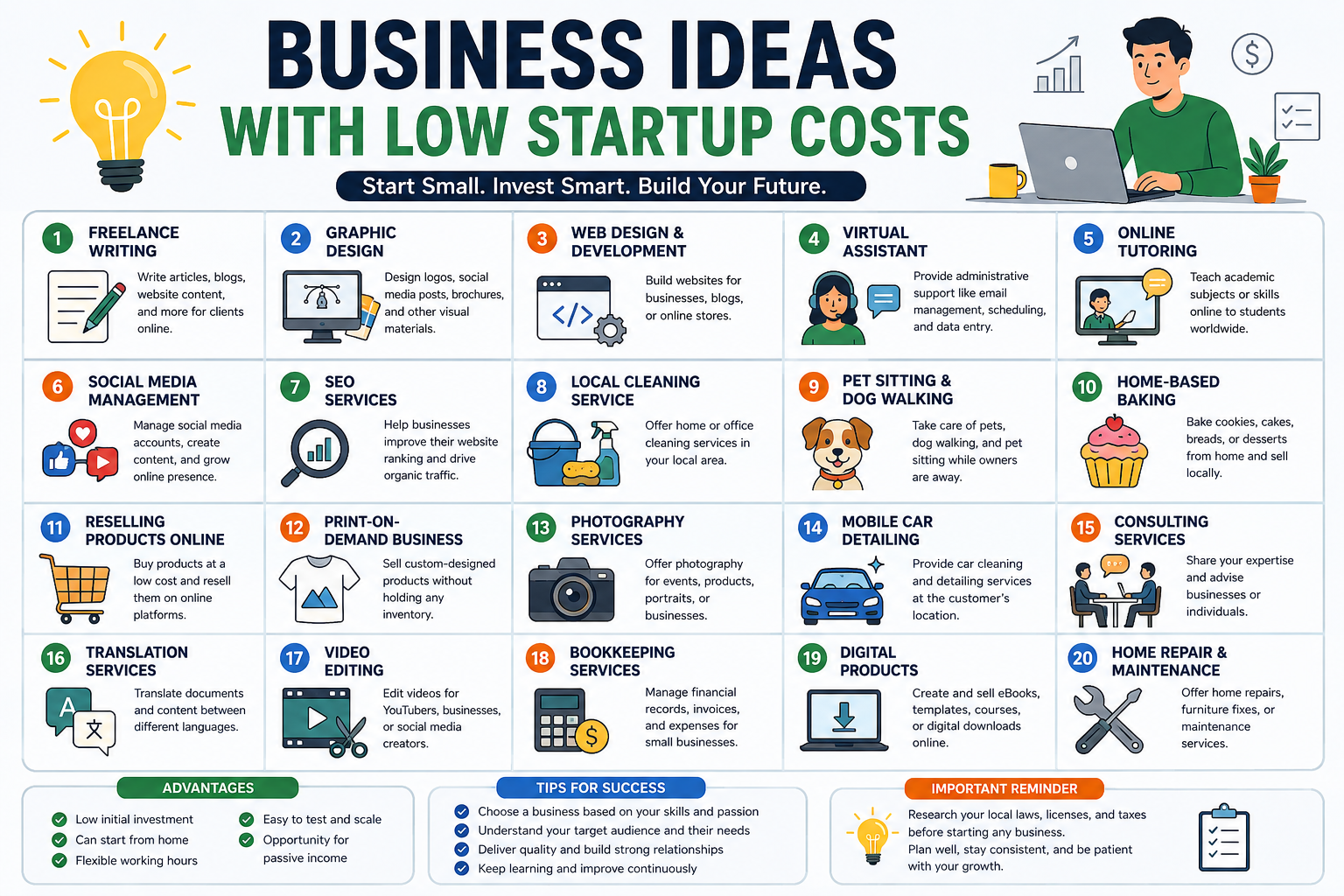
20 Business Ideas With Low Startup Costs
1. Freelance Writing
Freelance writing is a service business in which individuals create written material for clients.
Possible work includes blog articles, website copy, product descriptions, newsletters, technical documentation, case studies, and business communications.
The initial requirements can be relatively simple: writing ability, a computer, internet access, and a way to present samples to prospective clients.
A stronger approach is to specialize rather than offering every possible type of writing. Someone familiar with technology, for example, can target technology companies and publications.
What to Consider
The main challenge is not producing one article; it is finding and retaining suitable clients. Writers should also understand research, fact-checking, editing, deadlines, copyright, and client requirements.
2. Graphic Design
Graphic design can be offered to businesses that need visual material without maintaining an in-house designer.
Services may include logos, social media graphics, brochures, presentations, advertisements, business cards, and website graphics.
Startup requirements depend on the type of work. A designer may need a capable computer and appropriate design software, but someone who already owns those resources may not need substantial additional equipment.
A portfolio is particularly important because prospective clients usually want to evaluate the quality and style of previous work.
3. Web Design and Development
Small organizations frequently need websites for information, lead generation, e-commerce, bookings, or online communication.
A web designer or developer can work on complete websites or specialize in particular areas such as WordPress development, landing pages, website maintenance, accessibility, or front-end development.
The initial cost can be relatively low compared with starting a physical business, but professional software, hosting, domain registration, development tools, and training may still create expenses.
The technical responsibility also continues after launch. Websites require updates, security maintenance, backups, performance monitoring, and occasional troubleshooting.
4. Virtual Assistant Services
Virtual assistants provide administrative or operational support remotely.
Typical tasks include scheduling, email management, research, spreadsheet work, document organization, customer support, data entry, and basic project coordination.
This model is particularly suitable for people who already have administrative or organizational experience.
Instead of presenting a long list of unrelated services, a new virtual assistant can create packages around a specific customer type or business need.
For example, one person might focus on administrative support for consultants while another specializes in e-commerce operations.
5. Online Tutoring
Online tutoring allows teachers and subject-matter specialists to provide lessons remotely.
Subjects can range from school mathematics and languages to programming, music, writing, test preparation, and professional skills.
A tutor may need a computer or tablet, reliable internet access, appropriate teaching materials, and a quiet environment.
The quality of the learning experience matters more than the technology alone. Clear explanations, preparation, punctuality, and appropriate lesson planning are central to building a sustainable tutoring service.
6. Social Media Management
Businesses often use social platforms to communicate with customers and publish updates.
A social media manager may help with content planning, captions, graphics, scheduling, community management, reporting, and basic strategy.
The work should not be confused with simply posting frequently. Different businesses have different objectives, audiences, and communication requirements.
A responsible provider should avoid promising specific sales or follower growth unless those outcomes can reasonably be supported by the proposed strategy.
7. SEO Services
Search engine optimization can be offered as a specialized service to businesses that want to improve the visibility and usefulness of their websites in organic search.
Possible services include keyword research, technical audits, on-page optimization, content planning, internal linking, structured data implementation, and performance analysis.
SEO is not a guaranteed-results business. Search rankings depend on many factors outside an individual consultant’s control, including competition, website quality, search engine changes, and the relevance of the content.
For that reason, transparent reporting and realistic expectations are essential.
8. Local Cleaning Service
Residential and small-office cleaning can be started on a local basis without maintaining a conventional office.
Basic supplies, transportation, protective equipment, marketing materials, and appropriate insurance or registration may be relevant depending on the location and services offered.
The business can initially be operated by one person and expanded only if demand justifies additional labor.
Trust is especially important because cleaners may work inside customers’ homes or businesses. Clear communication, punctuality, careful handling of property, and consistent standards can influence repeat business.
9. Pet Sitting and Dog Walking
Pet-care services can include dog walking, pet sitting, feeding visits, and other non-veterinary care.
The startup requirements may be modest, but the responsibilities should not be underestimated.
Pet owners need confidence that their animals will be treated responsibly. A provider should establish clear procedures for access to the customer’s property, emergency contacts, feeding instructions, medication responsibilities where legally and practically appropriate, and what happens if an animal becomes ill or injured.
Insurance and local requirements should also be researched before operating commercially.
10. Home-Based Baking
A person with baking skills can consider selling cakes, cookies, breads, desserts, or other food products from home where permitted.
This can be started more cautiously by offering a limited number of products instead of attempting to operate like a full bakery.
Food businesses require particular attention to hygiene, ingredient information, allergens, packaging, storage, and local regulations.
Rules for home food businesses differ considerably between jurisdictions, so legal requirements should be confirmed with the relevant local authorities before selling products.
11. Reselling Products Online
Reselling involves purchasing products and selling them at a higher price through an online marketplace, social platform, website, or another sales channel.
The model can be tested with a limited amount of inventory rather than a large warehouse operation.
However, the purchase price is only one part of the calculation.
A seller should consider shipping, packaging, marketplace fees, payment processing, returns, damaged goods, taxes, advertising, storage, and unsold inventory before deciding whether a product is commercially viable.
A Simple Profit Calculation
A basic calculation can be expressed as:
Net profit = sales revenue − product cost − selling expenses − operating expenses
This is more useful than looking only at the difference between the purchase and selling prices.
12. Print-on-Demand Business
Print-on-demand allows businesses to sell products featuring original designs without necessarily purchasing large quantities of inventory in advance.
Depending on the provider, products may include clothing, posters, stationery, accessories, or other merchandise.
The model reduces certain inventory risks because products can be produced after an order is placed.
However, the seller has less control over manufacturing and fulfillment than a business producing its own products. Product quality, shipping times, customer service, platform fees, and profit margins should therefore be evaluated before choosing a supplier.
13. Photography Services
Photography can become a small business for people who already possess suitable equipment and have the required skills.
Potential markets include portraits, product photography, events, property photography, business imagery, and social media content.
The equipment cost can vary considerably. Someone beginning with no equipment may need to spend substantially more than an experienced photographer who already owns a camera, lenses, lighting, and editing tools.
A portfolio and clear service agreement can help customers understand what they are purchasing.
14. Mobile Car Detailing
A mobile detailing business provides vehicle cleaning and detailing services at the customer’s location.
Potential services include exterior cleaning, interior cleaning, vacuuming, polishing, and other detailing work, depending on the equipment and local regulations.
The business may require cleaning chemicals, brushes, vacuum equipment, towels, protective equipment, transportation, and potentially water or electricity arrangements.
Environmental rules concerning wastewater and chemical use can vary by location and should be checked before operating.
15. Consulting Services
Consulting is based primarily on specialized knowledge and experience rather than physical inventory.
A consultant may advise businesses or individuals in areas such as operations, marketing, technology, human resources, management, or other professional fields.
The low physical overhead can make consulting attractive, but credibility is fundamental.
Someone should not present themselves as an expert in a field merely because the business model is inexpensive to start. Professional qualifications, previous experience, demonstrable results, and honest communication about limitations can make a substantial difference.
16. Translation Services
People who are genuinely proficient in two or more languages can provide translation services.
Possible clients include businesses, websites, publishers, researchers, and individuals.
Translation is more than replacing words from one language with words from another. Context, terminology, tone, cultural meaning, formatting, and subject-specific vocabulary can all matter.
Specialized translation may require additional knowledge or credentials, particularly for legal, medical, or technical material.
17. Video Editing
The growth of online video has created demand for editing services for businesses, creators, educational organizations, and other clients.
Editors may work on short-form videos, advertisements, tutorials, interviews, presentations, or longer productions.
The startup cost depends heavily on the existing computer and software available to the editor.
A portfolio is generally more persuasive than simply claiming to be experienced. Demonstrating different editing techniques can help clients understand what type of work they can expect.
18. Bookkeeping Services
Bookkeeping involves maintaining organized financial records and performing related administrative accounting tasks.
Because financial records are sensitive and errors can have consequences, this is not a field where someone should offer services without appropriate knowledge and understanding of applicable requirements.
Training, relevant experience, suitable software, data security practices, and local rules should be considered.
For someone with an accounting background, however, bookkeeping can be a service business that does not require a physical storefront.
19. Digital Products
Digital products can include templates, educational materials, design assets, spreadsheets, checklists, software tools, or other downloadable resources.
One attraction of this model is that the product does not necessarily need to be physically manufactured or shipped to every customer.
The difficult part is creating something genuinely useful and finding an audience.
A digital product that solves a specific problem can be easier to position than a generic collection of files. Quality, usability, licensing, customer support, and intellectual-property rights should also be considered.
20. Home-Based Repair or Maintenance Services
People with practical skills may be able to offer services such as basic furniture repair, equipment maintenance, sewing, alterations, bicycle servicing, or other appropriate local work.
The investment depends heavily on the trade.
Someone who already owns the necessary tools may be able to begin on a small scale, while a beginner may need to purchase specialized equipment and obtain training.
Some repair and maintenance activities can also be regulated, particularly when they involve electricity, gas, structural work, vehicles, or other safety-sensitive areas.
How to Choose Among Low-Cost Business Ideas
The cheapest business to start is not necessarily the best business to operate.
A useful way to compare opportunities is to examine five factors.
1. Existing Skills
Starting with an existing skill can reduce training time and initial expenditure.
If you already know how to design websites, for example, developing that skill commercially may make more sense than purchasing equipment for an unfamiliar physical business.
2. Customer Demand
Ask whether a specific group of people actually needs the product or service.
Talking directly with potential customers can reveal information that market assumptions cannot. Find out what problem they have, how they currently solve it, and what they consider valuable.
3. Initial Investment
Separate essential expenses from optional purchases.
A new business does not necessarily need expensive branding, premium software, a large inventory, or an elaborate office immediately.
4. Operating Costs
A business can have a low startup cost but expensive monthly operations.
Consider subscriptions, supplies, transportation, advertising, platform fees, insurance, maintenance, taxes, and other recurring expenses.
5. Ability to Test
The strongest low-cost ideas can usually be tested before major investment.
If you can acquire a few customers and learn from their feedback before expanding, you have more information on which to base the next investment.
Advantages of Low-Startup-Cost Businesses
Lower Initial Capital Requirement
Compared with capital-intensive businesses, some service-based models can begin with fewer physical assets.
This can reduce the amount of money exposed before the business has demonstrated demand.
Flexible Business Structure
Many low-cost businesses can be operated from home or remotely, depending on the work.
This can eliminate or reduce some commercial-property expenses.
Easier Market Testing
An entrepreneur can often offer a small service package before building a larger operation.
This makes it possible to learn what customers actually value.
Opportunity to Reinvest
When a business generates revenue, some of it can potentially be reinvested into better equipment, marketing, training, software, or additional staff.
The decision should be based on actual business needs rather than simply spending money because revenue has increased.
Limitations and Risks
Low Cost Does Not Mean Low Effort
A business requiring little money may still require considerable time.
Customer acquisition, administration, sales, fulfillment, accounting, customer service, and quality control all require work.
Competition Can Be Significant
Low barriers to entry often attract many providers.
A new business may therefore need a clear specialization, stronger service, better communication, or a more convenient customer experience.
Owner Dependence
Many service businesses initially depend almost entirely on the owner’s time.
If the owner stops working, revenue may stop as well. Building systems, recurring contracts, products, or a team can eventually reduce this dependence, but those changes require additional planning.
Unexpected Expenses
Equipment can fail. Customers can request refunds. Advertising can perform poorly. Inventory can remain unsold.
Maintaining some financial reserve can help a new business handle expenses that were not included in the initial plan.
Real-World Customer Perspective
Customers generally do not care how much money a business spent to launch.
They care whether the service solves their problem.
A client hiring a web developer wants a functional website. A tutoring customer wants useful instruction. A cleaning customer expects the agreed work to be completed properly. A company hiring a writer needs accurate and appropriate content.
This means professionalism can matter more than appearance.
Clear pricing, realistic deadlines, written agreements, accurate invoices, responsive communication, and dependable service can help a small business establish credibility without requiring a large physical presence.
Is a Low-Cost Business Legitimate and Trustworthy?
A business does not need a large investment to be legitimate.
Legitimacy depends on factors such as whether the business operates honestly, complies with applicable laws, accurately represents its services, protects customer information, and fulfills its commitments.
Requirements vary by jurisdiction and industry. Registration, taxes, licenses, permits, insurance, professional qualifications, consumer-protection rules, and data-protection obligations may apply.
Businesses operating in regulated areas should verify the relevant requirements rather than assuming that a home-based or online operation is automatically exempt.
Customers can also protect themselves by checking business information, reviewing terms, asking questions, and avoiding offers based on unrealistic promises.
How to Start a Low-Cost Business Step by Step
Step 1: Choose a Specific Problem
Start with a customer problem rather than a business name or logo.
For example, instead of simply deciding to “start a marketing business,” identify a specific problem such as helping local businesses improve their website content.
Step 2: Define the Customer
Determine who is most likely to need the service.
A clearly defined customer makes pricing, marketing, communication, and service development easier.
Step 3: Calculate the Minimum Startup Cost
List only the expenses required to serve the first customer.
Separate these from purchases that can wait until the business generates revenue.
Step 4: Test the Offer
Talk to potential customers and attempt to sell a small version of the service.
Actual customer behavior is more informative than assumptions about what people might buy.
Step 5: Track Revenue and Expenses
Maintain accurate records from the beginning.
Knowing revenue without knowing expenses gives an incomplete picture of business performance.
Step 6: Improve Before Expanding
Use customer feedback to improve the service.
Expansion should follow evidence of demand rather than simply the desire to appear larger.
Frequently Asked Questions
What are the best business ideas with low startup costs?
There is no single best option. Freelancing, tutoring, virtual assistance, web development, cleaning, pet care, consulting, and certain online businesses can have relatively low initial capital requirements, depending on existing skills and local costs.
Can I start a business with very little money?
Some businesses can be started with limited capital, particularly those based on skills or services. However, even a small business can have expenses for equipment, software, transportation, marketing, registration, insurance, taxes, or supplies.
What is the cheapest business to start?
Skill-based services can have particularly low physical startup requirements because the entrepreneur sells expertise or labor rather than maintaining inventory. The actual cost depends on the equipment, training, and legal requirements associated with the service.
Are low-cost businesses profitable?
A low startup cost does not guarantee profitability. Profit depends on factors such as customer demand, pricing, operating expenses, competition, productivity, repeat business, and the quality of the service or product.
Should I start a business part-time?
Part-time operation can be a practical way to test an idea while limiting the financial risk associated with immediately depending on the business for all income. Whether it is suitable depends on the type of business and the time required to serve customers.
How do I choose the right low-cost business?
Start by comparing your existing skills, available capital, time, local demand, competition, operating expenses, and legal requirements. An idea that fits your capabilities and has identifiable customers is generally more practical than choosing solely because its startup cost appears low.
Final Takeaway
There are many business ideas with low startup costs, but inexpensive entry should not be confused with easy success.
Service businesses can be attractive because they often require fewer physical assets than inventory-heavy or location-dependent businesses. Freelancing, tutoring, web development, consulting, cleaning, pet care, and other specialized services can be started on a small scale when the entrepreneur has the appropriate skills and meets applicable requirements.
The most reliable starting point is not an expensive business plan or a long list of equipment. It is a clear understanding of the customer, the problem being solved, the cost of delivering the solution, and the amount customers are realistically willing to pay.
Start with the smallest sensible version of the business, keep accurate financial records, verify legal requirements, listen to customers, and increase spending only when there is a practical reason to do so. That approach keeps the initial risk manageable while giving the business room to develop based on real-world evidence rather than assumptions.