
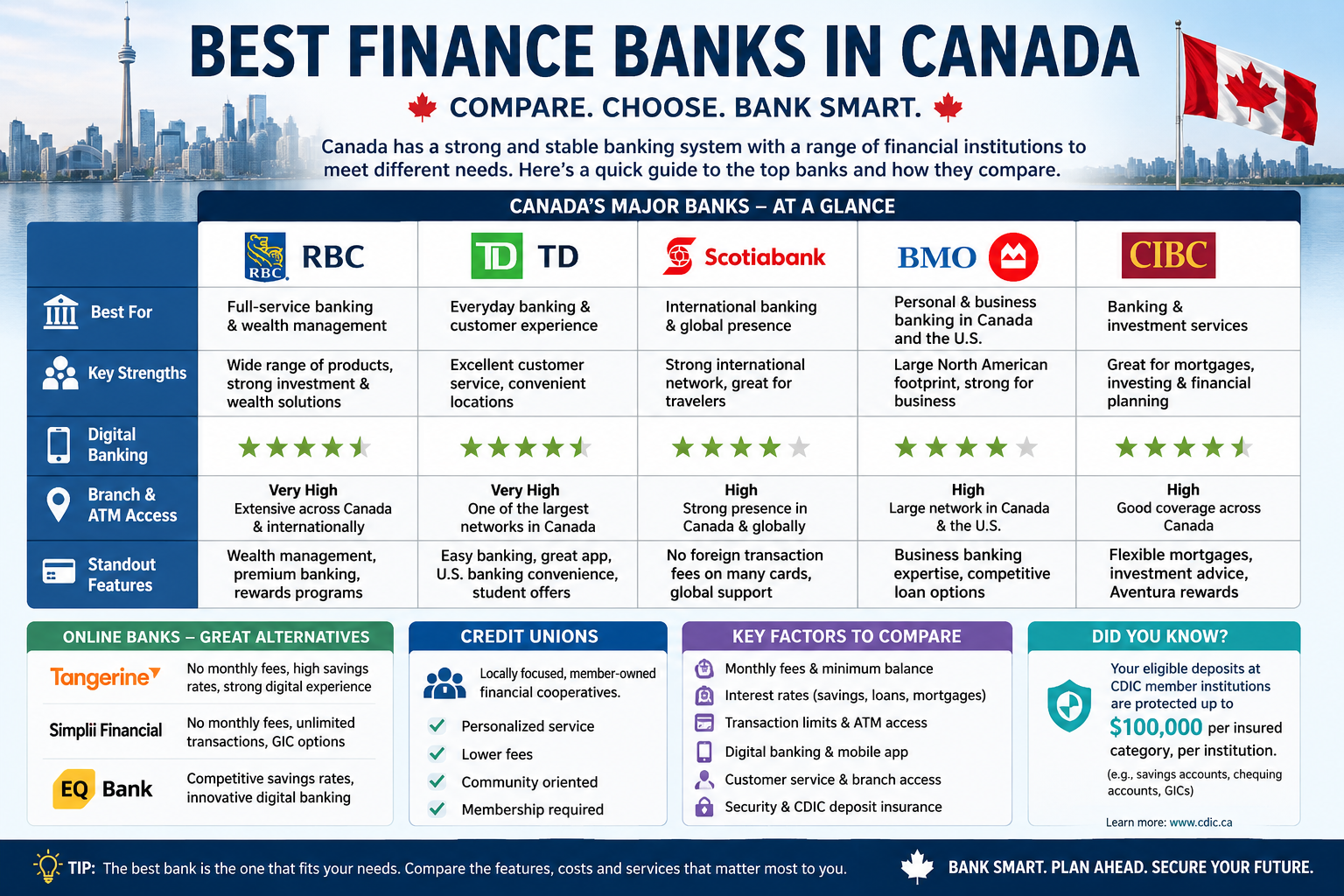

Choosing among the best finance banks in Canada is not simply a matter of picking the biggest name. Canadian consumers have different financial priorities. One person may want a low-cost chequing account, another may be searching for a competitive savings account, while a family may care more about mortgages, credit cards and long-term financial planning.
Canada has a highly developed banking system that includes large national banks, online banks, credit unions and specialized financial institutions. The country’s major banks provide a broad selection of personal and commercial services, while smaller and digital-first institutions often compete through lower fees, specialized products or competitive savings rates.
For many Canadians, the most familiar names are RBC, TD, Scotiabank, BMO and CIBC. These institutions offer everything from everyday banking and mortgages to investment and wealth-management services. However, the right choice depends on what you actually expect from your bank.
A good banking decision should consider account fees, interest rates, transaction limits, branch availability, digital banking, borrowing costs, investment choices, customer service and deposit protection. Looking at these factors together provides a much more useful picture than relying on a simple ranking.
What Are the Best Finance Banks in Canada?
The best finance banks in Canada are financial institutions that provide reliable banking services while offering products and features appropriate for different financial situations.
A full-service bank may provide chequing and savings accounts, credit cards, personal loans, mortgages, investment accounts, business banking and wealth-management services. Some customers prefer having all of these services with one institution, while others deliberately use several financial providers to obtain better rates or lower fees.
The term “best” is therefore subjective.
A bank that is ideal for someone buying a home may not be the best option for a student who only needs a basic chequing account. Similarly, an investor may care more about investment fees and available products than branch locations.
Canada’s banking sector includes both federally regulated banks and other financial institutions. The country’s commercial banking system operates under the federal Bank Act, while the wider financial system includes banks, credit unions, financial markets and payment infrastructure.
A quick comparison
| Bank or banking type | Particularly useful for | Main consideration |
|---|---|---|
| RBC | Full-service banking | Broad range of financial products |
| TD | Everyday banking | Combination of branches and digital services |
| Scotiabank | International needs | Strong international presence |
| BMO | Personal and business banking | Broad North American operations |
| CIBC | Banking and wealth services | Personal finance and investment options |
| Online banks | Lower-cost digital banking | Limited physical branch access |
| Credit unions | Local banking | Membership and regional availability |
This table is a starting point rather than a universal ranking. Account terms, rates and fees can change, so customers should always check the current product details before opening an account.
Background and History of Banking in Canada
Canada’s banking system has developed over many decades and is built around a relatively small number of large financial institutions.
The Bank of Montreal, established in 1817, is the oldest of Canada’s major banks. Other large institutions developed through mergers, acquisitions and expansion over the following centuries, eventually creating the major banking groups Canadians recognize today.
The modern system is not limited to traditional branches. Banks now operate through mobile applications, websites, automated teller machines, telephone banking and increasingly sophisticated digital payment systems.
The federal Bank Act plays an important role in Canada’s banking framework. Canada’s commercial banks are privately owned institutions that have been chartered under federal legislation, and the banking system also includes foreign-owned institutions and branches.
The Bank of Canada has a different role from commercial banks. It is Canada’s central bank and does not provide ordinary personal banking accounts. Its responsibilities include monetary policy, financial-system stability, currency and oversight of important payment infrastructure.
That distinction is worth understanding because people sometimes confuse the Bank of Canada with a consumer bank. You cannot open a normal chequing or savings account with the Bank of Canada.
How Banking Services Operate in Canada
For most consumers, banking starts with a basic transaction account.
A chequing account is generally used for everyday activities such as receiving employment income, paying bills, transferring money and making debit-card purchases. A savings account is designed more toward holding money that is not needed immediately.
Banks earn revenue in several ways. They may charge account and service fees, earn interest from lending activities and generate income through credit cards, investment services and other financial products.
Borrowing works in the opposite direction from saving.
When a customer takes out a mortgage, personal loan or line of credit, the bank provides funds and charges interest according to the terms of the agreement. The cost of borrowing depends on factors such as the interest rate, repayment period, loan amount and product structure.
Credit cards are another form of borrowing. Paying the balance in full by the due date can help avoid interest on purchases under the card’s terms, while carrying a balance can result in significant interest costs.
Why interest rates matter
Interest rates influence both sides of personal finance.
A higher savings rate can help a customer earn more from cash that would otherwise sit unused. On the other hand, a higher borrowing rate increases the cost of loans and credit.
This is why comparing banks only by their account fees can give an incomplete picture.
Someone with $500 in a basic chequing account may care primarily about monthly fees. Someone holding $50,000 in savings may care much more about the interest rate.
A homeowner with a large mortgage will naturally pay more attention to borrowing costs than a customer who does not use credit.
Best Finance Banks in Canada for Different Customers
There is no single ranking that works for everyone. A better approach is to examine what each major institution can offer different types of customers.
RBC: Best for a Broad Financial Relationship
Royal Bank of Canada, commonly known as RBC, is one of Canada’s largest financial institutions.
Its extensive range of services means customers can use one institution for everyday banking, credit cards, mortgages, lending, investments, insurance-related financial services and wealth management.
This breadth can be useful for customers who prefer convenience. Instead of maintaining separate relationships with several providers, they may be able to manage many financial needs through one organization.
Everyday banking with RBC
A customer might use an RBC chequing account for salary deposits and regular spending while maintaining a savings account for emergency funds.
As financial circumstances change, the same customer may eventually use RBC for a mortgage, investment account or other financial service.
This creates convenience but does not automatically mean every RBC product will be the cheapest or most competitive option available.
Who should consider RBC?
RBC may appeal to:
- Customers wanting many financial products under one institution
- People who value established banking infrastructure
- Customers interested in wealth-management services
- Homebuyers comparing mortgage options
- Business owners seeking banking services
The main point is breadth. RBC’s strength is not necessarily that every individual product is the best-priced product in Canada, but that customers can access a large financial ecosystem.
TD: Strong Option for Everyday Banking
Toronto-Dominion Bank, generally known as TD, is another major Canadian financial institution.
TD provides personal banking, mortgages, credit cards, loans, investment services, commercial banking and wealth-management products.
For many consumers, the attraction is the combination of conventional banking and digital access.
TD for everyday consumers
Someone who regularly visits branches may place significant value on physical access.
Another customer may rarely visit a branch and primarily use mobile banking. In that case, app functionality, online transfers, bill payments and account management may matter more.
TD’s broader North American presence can also be relevant for customers with financial connections between Canada and the United States.
Who should consider TD?
TD can be worth comparing for:
- Everyday banking customers
- Families managing several financial products
- Homebuyers
- Customers who value branch access
- People with Canadian-U.S. financial connections
- Customers interested in investment and wealth services
The important step is to compare the exact account and fee structure rather than choosing solely because TD is a large institution.
Scotiabank: An Important Choice for International Banking
The Bank of Nova Scotia, better known as Scotiabank, is one of Canada’s largest banks and has a particularly recognizable international footprint.
That international orientation can make the bank relevant to customers who travel frequently, have family abroad or conduct financial activities across borders.
Scotiabank provides personal and commercial banking, credit cards, mortgages, lending, investment products and wealth-management services.
International banking considerations
Customers dealing with foreign currencies should pay attention to exchange rates and foreign transaction costs.
A bank can have an excellent reputation while a particular international transaction may still be expensive.
When comparing international banking, examine:
- Foreign exchange rates
- Foreign transaction fees
- ATM fees abroad
- International transfer costs
- Availability of foreign-currency accounts
- Travel-related card benefits
- Conditions attached to those benefits
Who should consider Scotiabank?
It may be particularly relevant for customers who:
- Travel internationally
- Have financial relationships outside Canada
- Want a large Canadian bank
- Need multiple personal banking products
- Are interested in international financial services
International banking should still be evaluated transaction by transaction because fees and exchange rates can make a substantial difference.
BMO: A Long-Established Canadian Banking Option
Bank of Montreal, usually called BMO, is another major Canadian financial institution with a long history.
The bank provides personal banking, commercial banking, mortgages, credit cards, loans, investments and wealth-management services.
BMO also has a significant presence in the United States, making it relevant to some customers and businesses with North American financial activities.
BMO for personal finance
For an individual customer, the important question is not simply whether BMO is a large bank.
Instead, compare the specific products.
A basic customer might care about:
- Monthly account charges
- Number of included transactions
- ATM access
- Savings rates
- Mobile banking
- Overdraft policies
A homeowner may care more about mortgage rates, terms and prepayment conditions.
A business owner could place greater importance on commercial lending, merchant services and business account features.
Who should consider BMO?
BMO can be a useful institution to compare for:
- Individuals
- Families
- Homebuyers
- Investors
- Business owners
- Customers with Canadian-U.S. financial connections
Its broad product range makes it possible to build a substantial banking relationship, although individual product pricing should always be compared with competitors.
CIBC: A Strong Banking and Wealth-Management Option
Canadian Imperial Bank of Commerce, or CIBC, provides personal and commercial banking alongside investment and wealth-management services.
Its services cover everyday accounts, mortgages, credit cards, loans, investing and financial planning.
CIBC for long-term financial planning
Banking needs often change over time.
A young adult may initially need only a basic account. Later, that person might need a mortgage, registered investment account or retirement-planning assistance.
A full-service institution such as CIBC can potentially support several stages of that financial journey.
That convenience is useful, but customers should still compare investment fees and product costs. A bank’s wealth-management division and its self-directed investment options can have very different pricing structures.
Who should consider CIBC?
CIBC may be worth comparing if you are interested in:
- Everyday banking
- Mortgages
- Personal lending
- Investing
- Retirement planning
- Wealth-management services
- Business banking
Online Banks in Canada: A Different Approach
The rise of online banking has changed the Canadian financial landscape.
A digital-first bank does not need to operate a large network of traditional branches. That can allow it to structure its products differently from traditional branch-based institutions.
Online banks may compete through:
- Lower monthly fees
- Competitive savings rates
- Digital account opening
- Mobile banking
- Online transfers
- Simplified account structures
However, the trade-off can be limited physical branch access.
For someone who deposits cash regularly or prefers speaking with a banker face to face, a traditional bank may be more convenient.
For someone who manages everything through a smartphone, the absence of branches may not matter much.
When an online bank makes sense
Consider an online bank if you:
- Rarely use physical branches
- Want to minimize banking fees
- Keep substantial savings
- Prefer mobile banking
- Are comfortable managing accounts independently
Do not assume every online bank automatically has better rates. Compare the current terms just as you would with a traditional institution.
Credit Unions vs. Banks in Canada
Credit unions are another important part of Canada’s financial system.
Unlike traditional shareholder-owned banks, credit unions operate under a cooperative model. Membership requirements and structures vary depending on the institution and province.
Some customers appreciate the community-oriented approach of credit unions.
A local credit union may understand regional customers particularly well and may offer a more personal branch experience.
However, accessibility can vary. A credit union with an excellent branch network in one province may not be convenient for someone who moves elsewhere.
Bank or credit union?
Consider a bank if you prioritize:
- Large national coverage
- Extensive ATM access
- Broad product selection
- Large digital infrastructure
- Cross-country convenience
Consider a credit union if you prioritize:
- Local service
- Community relationships
- Cooperative ownership
- Regional financial services
Neither model is automatically better. The product terms and service experience are what matter.
Key Features to Compare Before Opening an Account
Choosing among the best finance banks in Canada requires looking beyond the brand name.
1. Monthly Account Fees
Monthly fees can seem insignificant, but they add up.
For example, a $15 monthly fee equals $180 over a year before considering any other charges.
Some accounts waive the fee if you maintain a specified balance or meet other requirements.
Before opening an account, determine exactly how the fee waiver works.
2. Minimum Balance Requirements
A bank account may advertise a monthly fee but allow customers to avoid it by maintaining a minimum balance.
That arrangement is not automatically beneficial.
If you must keep thousands of dollars sitting in a low-interest account just to avoid a fee, compare the opportunity cost.
The money could potentially earn interest elsewhere.
3. Transaction Limits
Some accounts include a certain number of monthly transactions and charge fees after that limit.
If you make frequent transfers, bill payments or debit purchases, transaction limits can become important.
Estimate your normal monthly activity rather than selecting an account based solely on its headline price.
4. Savings Interest Rates
Savings rates are particularly important when you maintain a significant cash balance.
However, distinguish between:
- Standard interest rates
- Promotional rates
- Bonus rates
- Tiered rates
- Conditional rates
A promotional rate may look attractive but last only for a limited period.
Always determine what rate applies afterward.
5. ATM Availability
ATM access can be important for people who regularly use cash.
Large banks generally provide extensive ATM networks, while online institutions may rely more heavily on partner networks or reimbursement arrangements.
Check the actual terms before assuming ATM withdrawals will be free.
6. Mobile Banking
A modern banking relationship is increasingly digital.
Important features may include:
- Biometric login
- Account alerts
- Mobile cheque deposits
- Bill payments
- Inter-account transfers
- Card controls
- Spending information
- Electronic statements
- Security notifications
Convenience matters because most customers interact with their bank digitally far more often than they visit a branch.
Mortgages and Home Financing
For many Canadians, the mortgage is the most financially significant banking product they will use.
That makes mortgage comparison especially important.
A mortgage should not be selected based only on the advertised interest rate.
Consider:
- Fixed or variable rate
- Mortgage term
- Amortization period
- Prepayment privileges
- Penalties
- Portability
- Renewal conditions
- Payment frequency
- Additional fees
A slightly lower interest rate may not always produce the best overall outcome if the mortgage has restrictive conditions.
Fixed vs. variable mortgages
A fixed-rate mortgage provides greater payment predictability because the interest rate remains fixed for the agreed term.
A variable-rate mortgage can change as market conditions and the relevant rate move.
Neither option is universally better.
The appropriate choice depends on a customer’s financial capacity, risk tolerance and expectations about future rates.
Credit Cards and Personal Loans
Banks also compete heavily in credit cards.
The best card depends on spending patterns.
Some cards emphasize:
- Cash back
- Travel rewards
- Air miles
- Grocery rewards
- Insurance benefits
- Low annual fees
- Premium travel benefits
A rewards card is not automatically better if its annual fee exceeds the value of the rewards you actually earn.
Similarly, customers considering personal loans should compare the annual interest rate, fees, repayment schedule and total cost.
Investment and Wealth-Management Services
Banking and investing are related but not identical.
A savings account is designed to preserve and potentially earn interest on cash.
An investment account can hold assets whose values fluctuate.
Investment choices can include:
- Stocks
- Bonds
- Mutual funds
- Exchange-traded funds
- GICs
- Other investment products
The level of risk varies significantly.
Customers should also understand the difference between self-directed investing and professional wealth management.
Self-directed investing
A self-directed investor chooses investments independently.
This can provide more control and potentially lower costs, but it requires knowledge and responsibility.
Professional wealth management
A wealth-management relationship may provide financial planning, portfolio management and advice.
The convenience can be valuable, particularly for people with complex financial situations.
However, customers should understand the fees and services included.
Advantages of Canada’s Major Banks
Large Canadian banks have several practical advantages.
Extensive product selection
A major institution can often provide banking, borrowing, credit and investment products under one roof.
National presence
Large banks generally provide services across multiple provinces and cities.
That can be useful for people who relocate.
Digital infrastructure
Major banks have invested heavily in mobile and online banking.
Customers can perform many tasks without visiting a branch.
Established financial infrastructure
Canada’s major banks form an important part of the country’s financial system. The Bank of Canada’s 2026 Financial Stability Report said Canada’s large banks remained resilient and well positioned to support the economy despite a more challenging environment.
Limitations of Large Canadian Banks
Large does not automatically mean cheapest.
Fees can be higher
Some traditional accounts have monthly fees or conditions for avoiding them.
Promotional offers can be temporary
A product may appear extremely competitive because of an introductory promotion.
Always check the standard terms.
Convenience can come at a cost
Having many services with one institution is convenient, but customers may potentially obtain better rates or lower fees by shopping around.
Customer experience varies
The quality of service can differ between branches, departments and individual situations.
A bank’s overall reputation does not guarantee that every customer will have the same experience.
Real-World Customer Examples
Example 1: A university student
A student may have relatively simple requirements.
The priorities could be:
- No or low monthly fees
- Unlimited or generous transactions
- Convenient mobile banking
- Easy ATM access
- Simple savings option
Paying extra for premium services may not provide much value.
Example 2: A working professional
A professional with regular income may want:
- Chequing
- Savings
- Credit card
- Investment account
- Emergency fund
- Potential mortgage
For this customer, the overall banking relationship may matter more than one isolated account.
Example 3: A homeowner
A homeowner should focus heavily on mortgage costs.
Even a small difference in the interest rate can become meaningful over a large loan balance and long repayment period.
Mortgage flexibility should also be considered.
Example 4: A frequent traveler
A frequent international traveler may care about:
- Foreign exchange
- International ATM fees
- Foreign transaction charges
- Travel insurance
- Airport benefits
- Global card acceptance
A bank with a strong international presence may be worth considering, but the actual card and account terms remain more important than the bank’s name.
Example 5: A small-business owner
A business owner may need:
- Business chequing
- Merchant services
- Payroll support
- Business credit cards
- Commercial loans
- Lines of credit
- Cash-management services
In this case, personal banking fees may be far less important than business financing and payment-processing costs.
Is Banking in Canada Safe and Legitimate?
Canada has a formal financial safety framework, although consumers should understand what each part actually protects.
The Bank of Canada supports the stability and efficiency of Canada’s financial system, while other federal organizations have specific supervisory and deposit-insurance responsibilities.
One of the most important protections for ordinary depositors is provided through the Canada Deposit Insurance Corporation (CDIC).
CDIC automatically protects eligible deposits at member institutions up to $100,000 per insured category, per member institution, including principal and interest. Eligible products can include chequing accounts, savings accounts and GICs.
That protection does not mean every financial product sold by a bank is insured.
Stocks, bonds, mutual funds and ETFs are not covered by CDIC deposit insurance.
This distinction is particularly important for investors.
Understanding the $100,000 limit
Suppose someone has:
- $70,000 in a savings account
- $20,000 in a chequing account
- $30,000 in a GIC
If those eligible deposits fall within the same insurance category at the same CDIC member institution, they are combined for coverage purposes rather than each receiving a separate $100,000 limit.
CDIC coverage can apply separately across recognized insurance categories, which include categories involving joint deposits and certain registered plans.
Customers with substantial cash holdings should therefore understand the structure rather than assuming every account receives a separate $100,000 limit.
Important Things to Know Before Choosing a Canadian Bank
Read the complete fee schedule
Do not rely exclusively on advertisements.
Check monthly fees, transaction charges, overdraft fees, ATM fees and other service costs.
Check promotional conditions
If an account offers a special interest rate, determine when the promotion ends.
Compare the regular rate
A promotional rate is useful only for the period during which it applies.
Consider your actual banking behaviour
If you never visit branches, paying more for branch-oriented services may not make sense.
If you frequently deposit cash, physical branches may be valuable.
Think about your future needs
A basic chequing account may be enough today, but your financial needs could change.
You may eventually need:
- A mortgage
- Investment services
- Business banking
- Retirement planning
- Credit
- Insurance-related services
That does not mean you must use one bank for everything, but it is worth considering.
Do not confuse bank size with product quality
The biggest institution is not automatically the cheapest or best provider for a particular product.
Compare the product itself.
How to Choose the Best Finance Bank in Canada
A practical decision process can be surprisingly simple.
Step 1: Identify your primary need
Ask yourself whether you primarily need:
- Everyday banking
- Savings
- A mortgage
- A credit card
- Investments
- Business banking
- International banking
Step 2: Establish your priorities
Decide which factors matter most.
For example:
Student: fees and transactions
Saver: interest rate and accessibility
Homebuyer: mortgage rate and flexibility
Investor: fees and investment choices
Traveler: foreign exchange and international services
Business owner: financing and payment services
Step 3: Compare at least three providers
Do not stop at your existing bank.
Compare several products from different institutions.
Step 4: Calculate the actual annual cost
A $12 monthly fee is $144 per year.
A $20 monthly fee is $240 per year.
Likewise, even a small difference in savings interest can become meaningful when the balance is large.
Step 5: Reassess periodically
Banking products change.
Promotional offers end. Interest rates move. New digital banks enter the market.
Your financial needs also change.
The bank that was right for you five years ago may not be the best fit today.
Best Finance Banks in Canada: Final Assessment
The best finance banks in Canada are not defined by a single ranking.
RBC is a strong option for customers who want a broad financial relationship and access to numerous banking and wealth services.
TD is worth considering for everyday banking customers who value a combination of traditional and digital services.
Scotiabank can be particularly relevant to customers with international financial needs.
BMO provides extensive personal and commercial banking services and is worth comparing for individuals, families and businesses.
CIBC offers a broad combination of everyday banking, borrowing, investment and wealth-management services.
Meanwhile, online banks can be attractive for customers who prioritize digital convenience, lower fees or competitive savings products. Credit unions offer another alternative for people who prefer a cooperative and locally focused banking model.
The strongest approach is not to ask, “Which Canadian bank is number one?”
A better question is:
“Which bank offers the right combination of cost, access, features and financial products for my situation?”
That question leads to a much more useful comparison.
For everyday banking, look closely at fees and transaction limits. For savings, focus on the regular interest rate and conditions. For mortgages, examine the complete borrowing cost and flexibility. For investing, consider fees, available investments and the level of support you actually need.
And if you keep substantial deposits, understand CDIC protection rather than assuming every financial product is insured. Eligible deposits are protected up to $100,000 per insurance category at each CDIC member institution, subject to the applicable rules.
Frequently Asked Questions
What are the best finance banks in Canada?
The major banks most commonly considered include RBC, TD, Scotiabank, BMO and CIBC. Online banks and credit unions can also be excellent alternatives depending on the customer’s priorities, fees, savings needs and preferred banking experience.
Which bank is best for everyday banking in Canada?
There is no universal winner. RBC, TD, Scotiabank, BMO and CIBC all offer everyday banking products, while online banks may be attractive for customers prioritizing lower fees and digital convenience.
Which Canadian bank is best for savings?
The answer depends on the account and current interest rate rather than the bank’s overall size. Customers should compare the standard savings rate, promotional period, withdrawal conditions, monthly fees and minimum balance requirements.
Are Canadian bank deposits insured?
Eligible deposits at CDIC member institutions are generally protected up to $100,000 per insurance category, per member institution. Covered products can include eligible savings accounts, chequing accounts and GICs.
Is CDIC insurance available for stocks and ETFs?
No. CDIC deposit insurance does not cover stocks, bonds, mutual funds or ETFs. Those products are investments rather than eligible deposits and may be subject to different forms of investor protection.
Are online banks better than Canada’s major banks?
Not necessarily. Online banks may offer attractive fees or savings rates, but traditional banks can provide extensive branch networks, broader product ranges and in-person services. The better choice depends on how you actually use banking services.
Which Canadian bank is best for mortgages?
RBC, TD, Scotiabank, BMO and CIBC all offer mortgage products, but the cheapest or most suitable option can change with market conditions and individual circumstances. Compare the rate, term, penalties, prepayment privileges and total borrowing cost.
Which bank is best for international banking?
Scotiabank is one major Canadian institution with a particularly significant international presence, while RBC, TD and BMO also have substantial international or North American operations. For international transactions, however, compare actual exchange rates and fees rather than relying only on a bank’s international profile.
Should I keep all my money in one Canadian bank?
Not necessarily. Using multiple financial institutions can sometimes provide access to different products, rates or deposit-insurance categories. However, managing several accounts can also add complexity, so the decision should be based on your financial needs and the applicable account and insurance rules.
What should I compare before opening a Canadian bank account?
Start with monthly fees, minimum balance requirements, transaction limits, ATM access, savings interest rates and digital-banking features. If you expect to borrow or invest, also compare mortgage terms, lending rates, investment fees and available services.
Can the best bank for me change over time?
Yes. A student may prioritize no-fee banking, while a homeowner may later care more about mortgages and a retiree may focus on savings and income planning. Reviewing your banking products periodically can help ensure they still match your financial situation.
Final Take On best finance banks in Canada
The best finance banks in Canada are not necessarily the same for every customer. RBC, TD, Scotiabank, BMO and CIBC remain strong choices because they provide extensive banking, lending, investment and wealth-management services. However, online banks and credit unions can sometimes be more attractive for customers focused on lower fees, competitive savings rates or a more specialized banking experience.
The smartest choice is to compare the specific product you need, rather than choosing a bank simply because it is large or well known. Check account fees, interest rates, transaction limits, ATM access, digital-banking features, mortgage terms and investment costs before making a decision.
For customers with significant deposits, it is also important to understand CDIC deposit insurance, including its $100,000 coverage limit per insured category at each member institution.
Ultimately, the right Canadian bank is the one that provides the services you need at a reasonable overall cost while fitting the way you manage your money. A little comparison before opening an account can save money and make your banking relationship much more useful over the long term.